

"My pool's too small to actually swim in." It's the most common thing we hear from pool owners — usually said with a shrug, standing next to a perfectly good pool. The backyard pool gets used for cooling off and floating, the real swimming happens at a gym twenty minutes away, and eventually the pool starts to feel like a landscaping feature you pay to maintain.
Here's the part that surprises people: for swim training, your pool was never too small. You were just using the wrong kind of swim.
Why laps don't work in a backyard pool
Lap swimming needs distance. In a typical backyard pool you push off, take a couple of strokes, and you're at the wall again — more turning than swimming. It's the same reason serious swimmers tolerate crowded lanes at the gym: the pool at home just doesn't have the length. So the assumption becomes "small pool, no swimming," and the pool gets demoted to a place you stand in.
Swim in place instead
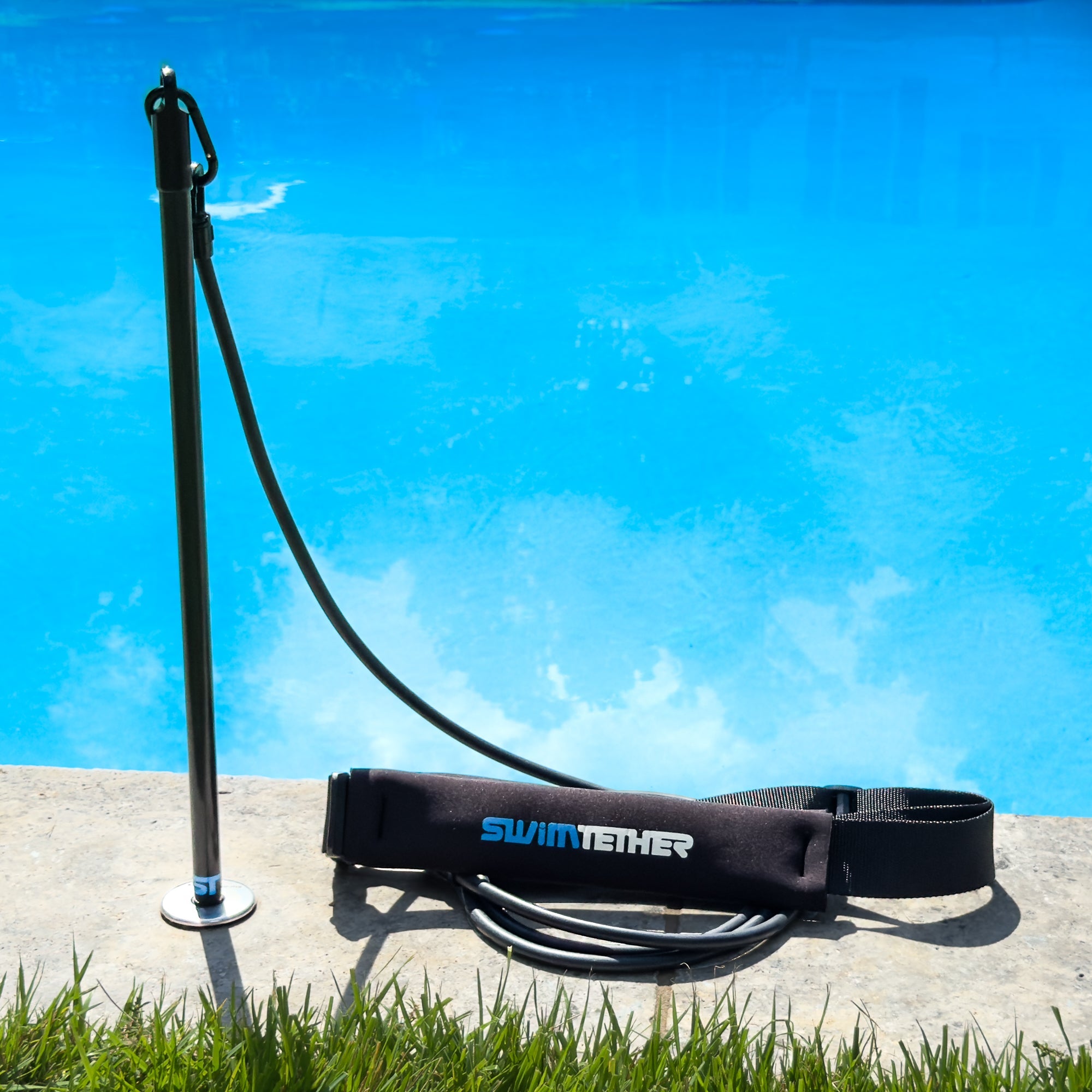
Tethered swimming flips the geometry. A belt goes around your waist, a stretch cord runs from the belt to a fiberglass pole mounted at the pool's edge, and you swim against the cord — in place, in the middle of your own pool. The pole bends naturally with your stroke, absorbing jolts, so the swim feels fluid rather than like pulling against a rope.
And the wall disappears. A pool swimmer doing laps spends a real chunk of every length on the wall — touch, push off, breathe, recover. Tethered, you swim and you keep swimming, until you stop. No flip turns, no resets, no interruption. Swimmers with big pools buy Tethers for exactly this reason; in a small pool it's not a bonus, it's the whole unlock.
Where the resistance comes from
The resistance isn't a setting on the gear — it comes from your own effort against the elastic cord. Swim hard and the cord loads up; relax your swim and the resistance relaxes with you. Cord length is about position, not difficulty: it's chosen so you swim in the right zone of your pool, comfortably off the wall. (More on that in how cord length affects your tethered swimming experience.)
Which model fits which pool
The ST1 is the small-water specialist — built for plunge pools and compact pools in the 8-to-14-foot range, where its low single-piece pole keeps your position stable and predictable. From about 10 feet up, the ST2 comes into play, including above-ground pools with a solid mounting surface. Longer in-ground pools open up the ST3, whose taller three-piece pole gives the swim its most open-water feel. If you're not sure where your pool lands, the model guide sorts it out in a minute, and our model comparison goes deeper on the differences.
The pool you almost gave up on
One of our favorite reviews starts: "I was about to get rid of my pool — too small for a 30-minute swim. Then I tried a Tether instead." That's the use case we built for. A pool that earns daily swims doesn't feel small anymore — it feels like the most convenient gym you own.
Ready to see what fits your setup? Build Your Kit walks through pole, base, and cord for your exact pool. Questions first? Text 770-702-4558 or email shop@swimtether.com.
Share:
How to Keep Swimming When You Travel
Swimming Into Fall: How to Stretch the Season